
How Long Does a Custom Table Take in Tulsa
Good things take time.
That's not a cliché when you're building furniture meant to outlast you. Heirloom tables aren't assembled on factory lines or shipped from warehouses. They're shaped by hand, one piece at a time, with patience baked into every step.
If you're asking how long a custom table takes, you're asking the right question. Timeline matters—not just because you're planning your space, but because it reveals how the table is actually built.
Fast furniture is built fast because corners get cut. Custom furniture takes longer because nothing is skipped.
In Tulsa, a handmade table from Five Feathers typically takes 8 to 12 weeks from design to delivery. Sometimes a little less. Sometimes a little more. It depends on the wood, the design, and the season.
But the timeline isn't just about waiting. It's about doing things right.
Why Custom Takes Longer
Mass-produced furniture is built for speed. Machines cut identical pieces. Assembly workers bolt them together. Finishes are sprayed in minutes and shipped before they're fully cured. The goal is volume, not longevity.
Custom woodworking works differently.
Design Takes Time
Every table starts with a conversation. What's your space like? How do you live? What do you need this table to do? Those answers shape the design, and design takes thought—not guesswork.
Wood Selection Takes Care
You can't just grab any board off the rack. The grain needs to match. The moisture content needs to be stable. The wood needs to be inspected for knots, cracks, and warping. Choosing the right lumber can take days.
Moisture Stability Matters
Wood moves. It expands in humidity and contracts in dry air. If you build with wood that hasn't acclimated to your climate, the table will warp, crack, or split within a year. So the wood sits. It adjusts. It stabilizes.
That waiting period isn't wasted time. It's insurance.
Joinery Requires Precision
Hand-cut mortise and tenon joints don't happen in five minutes. Neither do dovetails or breadboard ends. Each connection is measured, marked, cut, and test-fit. Sometimes twice. Precision doesn't rush.
Finishing Can't Be Fast-Tracked
A durable finish isn't one coat sprayed on and called done. It's multiple coats, each one drying and curing before the next goes on. Rushing this step leaves you with a sticky surface that scratches easily and wears unevenly.
The bottom line: Custom takes longer because every step is done with intention. You're not buying speed. You're buying quality that lasts decades.
The Design Phase
This is where ideas become real plans.
You reach out. We talk. You describe your space, your style, your vision. Maybe you send photos of your dining room. Maybe you share inspiration images. Maybe you just say, "I want something simple and strong."
From there, we measure. We ask about room flow. We discuss how many people you need to seat. We talk about wood type, table shape, and finish options.
Why This Phase Matters
Clarity here saves weeks later. If we nail down the design early, the build moves smoothly. If details are vague or keep changing, the timeline stretches.
We don't rush this part. We refine until it feels right—for you and for the build.
Average time: 1 to 2 weeks, depending on how quickly we align on the vision.
Selecting the Lumber
Not all wood is created equal.
Kiln-Dried vs. Air-Dried Boards
Kiln-dried lumber is heated in large ovens to remove moisture quickly. It's stable, predictable, and ready to use sooner. Most custom furniture uses kiln-dried wood because it minimizes risk.
Air-dried lumber is stacked and left to dry naturally over months or even years. It's gentler on the wood and can produce richer color, but it takes much longer to stabilize.
We typically work with kiln-dried lumber that's been acclimated to Oklahoma's humidity levels. That means it's already stable and ready to shape.
Why Walnut Selection Takes Care
Walnut is beautiful, but it's also particular. The color varies from board to board—some pieces are almost black, others have blonde sapwood streaks. Grain patterns shift. Knots appear.
Selecting walnut means sorting through dozens of boards to find ones that match in tone and grain. It's not something you rush through.
Wood Must Be Stable Before Shaping
Even kiln-dried wood needs time to acclimate to your local environment. We let it sit in the shop for at least a week before cutting. This prevents movement later—warping, twisting, or cracking after the table is finished.
Tip from the craftsman: The right board saves years of trouble. A bad board ruins months of work.
Average time: 1 to 2 weeks for selection and acclimation.
The Build
This is where the table comes to life.
Shaping
Rough lumber gets milled flat and square. Edges are jointed. Boards are planed to the exact thickness. Every surface is checked for consistency.
Joinery
Legs connect to aprons. Aprons connect to the tabletop. Mortises are cut. Tenons are shaped. Everything is test-fit, adjusted, and fit again. Strong joinery is what holds a table together for generations—not screws or brackets.
Glue-Up
Once all the pieces fit perfectly, they're glued and clamped. The table sits under pressure while the glue cures. This can't be rushed. If you pull the clamps too early, the joints weaken.
Sanding and Refining
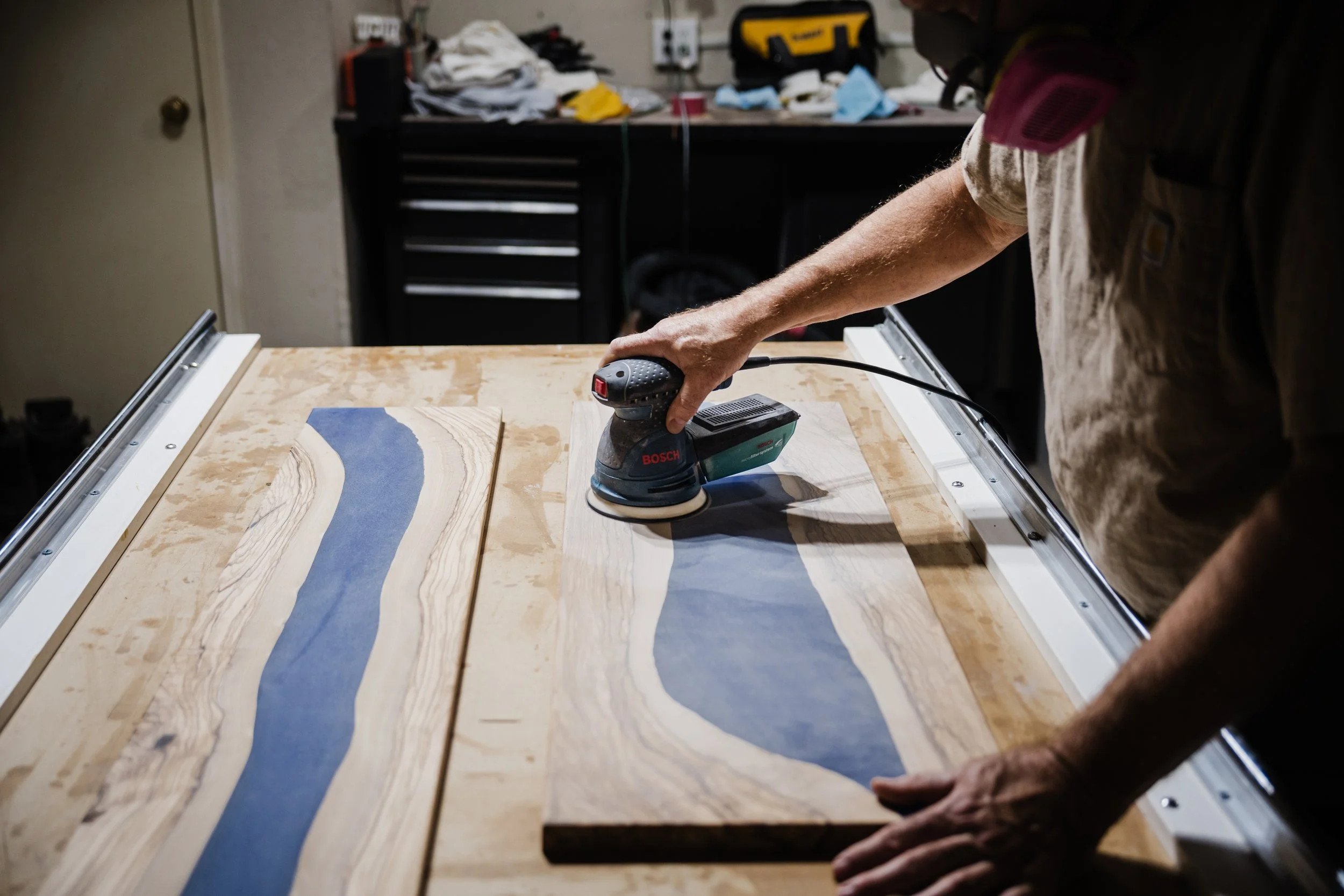
After the glue dries, the real refinement begins. Surfaces are sanded smooth—starting with coarse grits and working down to ultra-fine. Edges are eased. Corners are softened. Every surface is touched, checked, and touched again.
This is where the rhythm of slow craft shows up. Small pauses matter. Precision takes focus.
Average time: 3 to 5 weeks, depending on size and complexity.
The Finishing Stage
The finish protects the wood and brings out its natural beauty. But more importantly, it determines how the table wears over time.
Our Multi-Step Finishing Method
We don't spray one coat and call it done. We build up the finish in layers:
First coat soaks into the wood, sealing the grain.
Dry time: 24 to 48 hours.
Light sanding smooths any raised grain.
Second coat adds depth and protection.
Dry time: 24 to 48 hours.
Third coat (sometimes fourth) completes the build.
Final cure time: At least one week before delivery.
Why Dry and Cure Times Matter
Dry time is when the finish hardens to the touch. Cure time is when it fully hardens all the way through. A finish might feel dry in 24 hours, but it won't reach full durability for 7 to 14 days.
If you skip the cure time, the finish stays soft. It scratches easily. It shows water rings. It dulls quickly.
We don't skip it.
Tip from the craftsman: Heirloom durability comes from patience in the finishing stage, not just skill.
Average time: 2 to 3 weeks for multi-coat finishing and full cure.
Final Inspections
Before a table leaves the shop, it gets checked. Thoroughly.
What We Look For:
Smoothness: Every surface is touched by hand. No rough spots. No raised grain.
Alignment: Legs sit flat. The top is level. Nothing wobbles.
Edge Comfort: Edges are eased and smooth under the hand. No sharp corners.
Finish Clarity: The finish is even, clear, and free of dust or bubbles.
This final inspection protects your long-term investment. A table that leaves the shop perfect stays that way for decades.
Average time: A few hours to one day, depending on the piece.
Average Timeline for a Custom Table in Tulsa
Here's the realistic breakdown:
Phase Time Design 1–2 weeks Lumber selection 1–2 weeks Build 3–5 weeks Finishing and cure 2–3 weeks Final inspection 1 day Total 8–12 weeks
Factors That Affect Timeline:
Simple designs (rectangular, minimal detail) lean toward 8 weeks.
Complex designs (curves, inlays, custom joinery) push toward 12+ weeks.
Wood availability can add a week if we're sourcing rare or specific boards.
Seasonal workload affects timing—holiday season and spring are our busiest times.
The takeaway: Quality takes intention, not rush. A table meant to last decades is never built in a hurry.
How Limited Orders Impact Speed
We don't take every project that comes through the door.
At Five Feathers, we limit the number of builds we take on at any given time. That's intentional.
Why?
Clients get focus. When we're only working on a handful of tables, each one gets the attention it deserves. No rushing. No cutting corners.
Build quality stays high. We're not churning out furniture on an assembly line. Every joint is hand-cut. Every finish is hand-applied. That takes time and care.
No shortcuts. Limited orders mean we never have to sacrifice quality to meet a deadline. If a piece needs an extra day of sanding or another coat of finish, it gets it.
What This Means for You:
Your table isn't lost in a queue. It's not competing with 30 other projects. It's being built with full focus and intention.
But it also means we book out in advance. If you're ready to start your build, reach out sooner rather than later.
What Can Delay or Speed Up a Build
Not every table follows the exact same timeline. Here's what can shift it:
Wood Availability
If you choose a common wood like oak, we likely have it in stock or can source it quickly. If you want a specific grain pattern in walnut or a rare species like curly cherry, it might take longer to find the right boards.
Complex Designs
A simple rectangular table with straight legs? Faster. A live-edge slab with metal hairpin legs? Also faster. But a table with hand-carved details, curved aprons, or intricate inlays? That adds time.
Seasonal Workload
Spring and fall are our busiest seasons. Families are settling in, hosting holidays, or refreshing their homes. If you reach out during these times, the timeline might stretch slightly.
Client Response Time with Approvals
If we send you design options and you respond quickly, the build moves forward. If approvals take weeks, the timeline stretches. Clear communication keeps things moving.
Finishing Cure Time
This one is non-negotiable. Finish needs time to cure fully, and we won't deliver a table before it's ready. But if you're flexible on delivery date, we can coordinate timing to fit your schedule.
Conclusion
A custom table takes 8 to 12 weeks in Tulsa because every step matters.
Design takes thought. Wood selection takes care. Joinery takes precision. Finishing takes patience. And final inspections protect your investment.
You're not waiting for a table. You're waiting for heirloom-quality furniture built with intention—furniture that your kids will inherit and their kids will fight over.
Fast furniture falls apart. Custom furniture becomes part of your story.
Start Your Build
Ready to start the conversation?
Reach out to Five Feathers and share your vision. We'll walk you through the process, give you a clear timeline for your specific table, and answer every question along the way.
Limited orders keep quality high. If you're ready, let's talk.